
St. George Experience
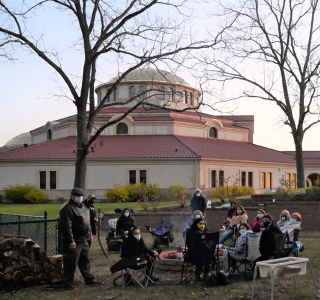
The parish family of St George invites you to experience the worship of the Orthodox Church, the outreach and charitable ministry of Christ’s Holy Church and the hospitality and fellowship of the faithful of St George. Christian Education for adults and youth are an integral part of our community. Our annual Festival (held in September) is one of our primary connections to the greater community of Fishers, Hamilton County and Indianapolis.

André Smith’s Long Journey to Orthodox Christianity
by David E. Sumner
André Smith has traveled on a long, twisted journey to embrace Orthodox Christianity. He says he grew up in a “Black Baptist church in east Indianapolis,” which was founded by his grandfather. At an early age, he walked down the aisle to make a “public profession of faith in Christ,” which is a custom in Baptist churches. But as he grew older, he wandered into other religions far from his Christian roots. “From around age eight or nine, I don’t think I belonged to an organized church for many years,” he says.
A tall gentleman with a quick wit and smile, his conversation is often sprinkled with jokes and humorous retorts. But he is deadly serious about Orthodoxy, and his conversation reflects a deep study of Orthodox theology and history.
During his college years at IUPUI (Indiana-Purdue University in Indianapolis) and later, he traveled six times to Japan to study martial arts and Buddhism. While he was there, he became fluent in Japanese. André graduated from IUPUI with a business degree in 2008. “I worked for the Marion County Sheriff’s Department in budgeting and finance for six years. After that, he moved to the private sector in 2011. The way I serve my clients, I am like the family doctor. I help clients discover their needs and then get them to a specialist,” he explains.
André never knew his father. His mother got involved in alcohol and drugs but later made “a complete 180 and became very serious about Christ,” he says. He describes the neighborhood where he grew up around 42nd and Shadeland as dangerous. “Where I lived was deep in gang territory. Every day was very precarious. I didn’t really know what would happen. Rival gangs were in the surrounding area around me.”
He attended Cathedral High School before graduating from Thomas Carr Howe High School. He took a few years off before attending Ivy Tech. He then transferred and graduated from the IUPUI School of Business with a finance degree. Smith met his Japanese wife, Kana, while both were studying at IUPUI. They returned to Japan for their marriage ceremony and were married in a Christian church. They have now been married for 19 years with two children, Ken, 16, and Charlotte, 10.
Sometime during college, he started studying martial arts. “My teacher was also a Buddhist priest. Now there are various schools of Buddhism. Even then I didn’t want to leave Christ fully behind. In the back of my mind I think in a lot of ways Buddhism prepared me for Orthodoxy. My school of Buddhism had a very much military application because it was in the context of martial arts training. Other schools might focus on enlightenment, but my school focused on how to apply Buddhism to win battles. When is the best time to attack the enemy? It was a legacy of warriors.”
He was not focused exclusively on Buddhism, however. During those years in the early 2000s, “I studied Astro-theology, ancient Egyptian religions, black consciousness, all of that. I was very much into reading Afro-centric scholars and the Black Panther kind of stuff. Of course, I believed what they said that ‘Christianity is a white man’s religion.’”
His first contact with an Orthodox Christian came from a chance encounter. “I didn’t really believe anything until I met Fr. Steven Bauman from Joy of All Who Sorrow Orthodox Church in Indianapolis (who reposed on Aug. 15, 2025). “He was walking around in his Orthodox clerical garb in 2015. I went up to him and said, ‘Who are you? What do you do?’ He said, ‘I am an Orthodox priest,’ and I said, “What is that?” and he said, ‘Come and see.’ So, we struck up a conversation on the street. I knew he was a holy man.
“I went to their bookstore and recognized right away that this was serious business. I went to my first Divine Liturgy, and I can still remember the sights, the sounds, smells and they hit me right in the face.
“We started coming to St. George in 2017 when we decided we needed a church. During this time, I learned that things I once thought about Christianity were all based on bad information. When I got to St. George and met Fr. Nabil, I told him, “I don’t know anything about anything. Teach me Christianity from the beginning. A lot of things got knocked down, a lot of bad thinking and bad theology got removed as obstacles. I feel my journey was one I needed to make. So, in Pascha 2018 we came in and were baptized and chrismated.”
André said that one of the important things that attracted him to Orthodoxy is that he felt his Japanese wife and family would feel comfortable here. “My wife could come here and worship and still be who she is. She wouldn’t have to deny or hide her culture.”
The physical aspects of worship also attracted him. “Through the bowing, the crossing, standing and sitting, the whole body is involved in worship. My martial arts philosophy is that the whole body is integrated into self-defense. It is like my martial arts training, but the next level and a more excellent way.”
Another attraction is the stability of the faith. “I won’t have to worry when Father Anthony retires, and we get a new priest. Yes, I expect some differences, but I don’t have to worry that the church will go in a radically different direction. The teaching will be the same.”
Most Sundays during Coffee Hour, you will find André sitting at a table surrounded by six or seven young men asking questions and having a discussion. St. George and other Orthodox churches have seen a large influx of young adults, especially men, since the Covid pandemic. He has personally sponsored six men for chrismation.
Asked about the influx of young men, he says, “Some are coming in from other churches, and some are coming in from atheism. When you come into an Orthodox church, you feel the holiness, there’s a tangible feeling. Many men, Black men in particular, are looking for shaping and molding on what it means to be a man. When they come here a lot of them are also looking for shelter.
“The church is an ark, and an ark is where you can ride out the storm. I think that’s a big piece of it. Many men feel alone, alienated or unappreciated. But here they find Christ, they find brotherhood, they find community. They also get to see Christ, who is the example of what does it mean to be a man. They want to grow. They want the discipline and the fasting, and they get it here.”
André is an Altar Server most Sundays and teaches the high school Sunday School class. “These young people will have to go out into the world and defend their faith. My job is to teach them as best as I can. I believe the Orthodox Church teaches the real and fundamental nature of reality.”
The next step in his journey is preparing to serve in the diaconate. “A lack of men willing to serve will hurt the church overall, and I am in a position that I can serve. We need more hands-on deck helping, so service to the Church is my main reason.” The Archdiocesan program he is participating in limits him to the diaconate. “I do not aspire to the priesthood. If you join the diaconate under this Archdiocesan program, you serve at this particular church, and I will not be allowed to seek the priesthood.”
After wandering in the wilderness of Buddhism, philosophy, and other religions, André’s journey has turned him into a rock of faith. “When it comes to these different systems, the only one that can really hold up in my view is the Orthodox Church. Obviously, I’m a sinner, and I have a long way to go. But I love being Orthodox. I love Christ, the Saints, and all of y’all.”
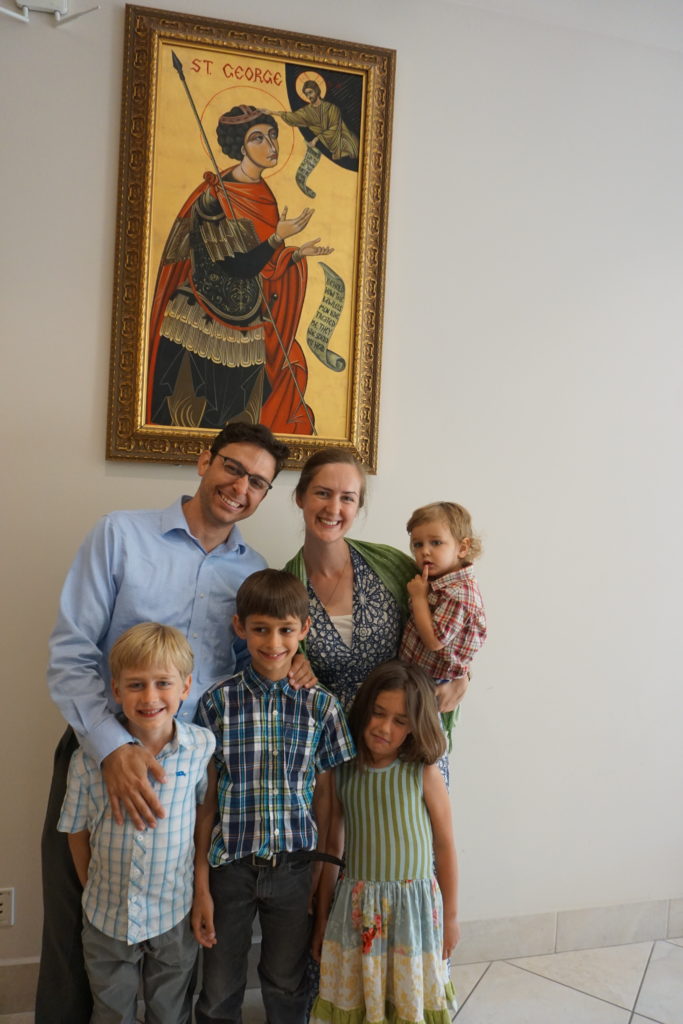
Journeying together into Orthodox Christianity
by David E. Sumner
James and Stephanie Romeo met while they were music students at Indiana University in Bloomington. Stephanie grew up in a suburb of Indianapolis where her family attended a Lutheran Church-Missouri Synod congregation. James grew up in southern California, where his family attended an independent evangelical church, which he describes as “reformed Baptist” in doctrine.
James plays the piccolo and flute, and Stephanie plays the cello. They met in the university’s Christian Musicians’ Fellowship. Both grew up with a strong Christian faith. James says, “The church was a big part of my life and a constant in my life. Our religious differences gave us a lot of interesting topics to debate, but we also had a lot in common in other ways.”
Reformed Baptists and Missouri Synod Lutherans can be loosely described as “evangelical,” but that’s where similarities end. Reformed Baptists were historically influenced by John Calvin’s theology and views of predestination. The doctrinal statement of James’s childhood church says, “We hold to a Reformed view of salvation.” Missouri Synod Lutherans, while more conservative than other Lutherans, practice a liturgical style of worship and baptize infants. Baptists do not baptize children or adults until they have reached a consenting age and make a public profession of faith.
Stephanie says, “It was not until I got to college and met James that I decided to read more about other Christian denominations. I thought that I knew a lot about doctrinal accuracy and more than Christians in other denominations. When I first met with the Christian musicians’ group at Indiana University, I thought I would go into that and tell everybody where I thought they were wrong. Well, I was wrong. When I started dating James, a lot of our discussions had to do with the differences between his background and mine.”
They married soon after graduating in 2010 and moved to Cleveland, Ohio, where James earned a master’s degree in music. Then they moved back to Southern California. “As it turned out I ended up being convinced from his side. And I went Calvinistic. We got married and we joined the church that he was a part of in San Diego. The church he was in was much more active, the congregation was younger, and I made many good friends there,” Stephanie says. Since 2013, they have had four children—who range in ages from two to nine.
They spent the next eight years in San Diego, where they began their journey into Orthodoxy. James taught music lessons and had periodic invitations to play for various professional ensembles in the region. James says, “We had visited one of the local Orthodox churches there on occasion. We sent our oldest son to a Greek Orthodox language school.
“But the seed for me was planted way further back,” he recalls. “My first exposure to Orthodoxy was through my grandmother. My parents were from northeast Ohio. I would go back fairly frequently in the summers or holidays and go with her to liturgy. That was my first exposure to Orthodoxy. I can’t really underestimate her influence. She was a lifelong Orthodox Christian and a devoted servant of the Church. The Church was her life, and her example left a mark on me.
Speaking of San Diego, Stephanie says, “Several years into our marriage we had children and started taking our oldest son when he was in kindergarten to a Greek language school. I really wanted him to learn Greek because his Greek grandmother had recently passed away, and I wanted us to continue the tradition of learning the Greek language.
“James by that time had started reading about Orthodoxy, but I had not. We had friends there through the school at St. Constantine and Helen Greek Orthodox Church. They befriended us and invited us to come to the inquirers class and started telling us about Orthodoxy,” says Stephanie.
James says, “We were both drawn to it together. There really wasn’t any friction in our process of moving towards Orthodoxy. I know that’s not the case for a lot of couples who are converts, but we were on the same page.”
About this time, James received a one-year contract offer to play full-time for a professional symphony orchestra in Canada. They moved to Canada and continued their journey into Orthodoxy. James and Stephanie give credit to the Orthodox priests they met in California (Angelo Maginas) and British Columbia (Fr. Michael Gillis) for influencing their journey.
“We decided this was just the perfect opportunity to study Orthodoxy more seriously. So, we found a church there–Holy Nativity Antiochian Orthodox Church in Langley, B.C.We were amazed by how welcoming everyone was. It was just a very beautiful congregation. Fr. Michael was very pastoral in his care and came to our home several times to talk with us. Both he and that parish were warm and welcoming. Being in a new place in a new country, which it meant a lot to be a substantial part of that community,” says Stephanie.
She continues, “By that time, we had just been doing lots of reading. And I started listening to Ancient Faith Radio podcasts, especially Fr. Thomas Hopko, and really appreciated what he was teaching especially about worship.”
After the year in Canada ended, they moved back to Indiana to live with family during the covid pandemic. “During covid, there were no performing arts jobs, and his Canadian work visa also expired. But by then we were definitely sure we wanted to become Orthodox,” Stephanie says.
In the fall of 2020, they started attending and taking catechumen classes at St. George Antiochian Orthodox Church in Fishers, a northern Indianapolis suburb, where Fr. Anthony Yazge is pastor. James cited three authors as influential in his journey: The Orthodox Church by Timothy Ware; Welcome to the Orthodox Church by Frederika Mathewes Green, and podcasts and books by Fr. Thomas Hopko.
James and Stephanie were chrismated at St. George Antiochian Orthodox Church on Holy Saturday in 2021 with their four children.
Stephanie says, “It’s just been more beautiful than I expected, the fullness and beauty of the truth that is here in the Orthodox Church goes way over my head, and I have enjoyed going deeper into the faith over time. I can see and appreciate so many things that actually turned me toward the Orthodox church.”
Reflecting on his journey, James says, “The nature of my relationship to Christ has become much more intimate and personal than I ever experienced in evangelical Christianity. This is due in large part to discovering the depth of the Orthodox Church’s confession of the incarnation, manifested in the real, bodily presence of Christ in the Eucharist, the iconography of Christ, and the many emphases of this doctrine in church teachings and liturgical references.”
He continues, “Calvinists teach that the bodily resurrection and ascension of Christ precludes His physical presence in the world today and will only be made manifest again physically at his second coming. This leaves Reformed Christians teaching only the spiritual presence of Christ on earth (in the sacraments, for example) or even no presence at all (the Zwinglian view), which means that the only way Christ can be experienced on earth is through one’s own spiritualized, disembodied ideation of Him. This lack of an objective presence of Christ ultimately became a stumbling block for me, as the validity of my faith felt only as consistent as my own ideas allowed.”
James says the doctrine of the Incarnation in Orthodoxy permeates everything and makes the presence of Christ real. “Ultimately, it was this lack of assurance that led to me searching for something deeper and more concrete. It is amazing to me to see the doctrine of the Incarnation permeating nearly everything about the Orthodox Church–from the iconography to the vestments to the physicality of liturgical practice and prayer.
He concludes, “The Orthodox Church has withstood the test of many, many persecutions over many generations, and the continuity of that is felt in the Church today. As evangelical churches have largely lost the culture wars they waged in the past 30 years, it is hard to view such a loss as anything less than apocalyptic. Being a part of a church that has staked its identity on something more grounded than the cultural battles of the day has been a huge comfort, knowing that the church will not change no matter the persecution it must endure.”
Reflecting on her journey, Stephanie says she also discovered a deeper and more intimate faith through Orthodox Christianity. “The immediate reaction I think many Protestants have when they hear of a former evangelical converting to Orthodoxy is a fear that we have abandoned the Gospel of Jesus Christ by turning to ‘high church’ liturgical practices that distract us from being honest about the sinfulness in our hearts and growing in our relationship with Jesus Christ. Even if prayer to the saints is not viewed as idolatry, then it is considered at least a distraction from praying to and building one’s relationship with Christ himself. But this is not the case.”
She continues, “In coming to Orthodoxy, I have found renewal of meaning and comfort in knowing that Christ promises to be with us even until the very end of the age. That is more than simply a spiritualized idea of remembering Him in our prayers, songs, studying of Scripture, and waiting for His return, but also it is a very physical presence in His body and blood in the Holy Eucharist and part of the peace which passes all understanding.
“I cannot say that Christ is not present with Protestant churches. Faith, which was planted in me as a seed by godly Protestants, has found in the Orthodox Church a rich soil in which to flourish and bear fruit. I have found the teachings and liturgical practice, especially confession, spurring me on more toward tending the garden of my own heart rather than being a distraction to avoid confronting my own failures and need for repentance.
“The experience of this is not just emotional, but very real as both physical and spiritual. As we say every Sunday, “Christ is in our midst. He is and ever shall be!” Stephanie concludes.
The economy started to open up in summer 2021 and James started getting performing gigs and invitations to audition. In May 2022, he was offered and accepted a full-time position playing with one of the largest performing arts organizations in the southwestern U.S. The Romeo family moved south in the summer of 2022, where their journey into Orthodoxy will continue.
This week at St. George orthodox
christian Church
Join us for a POWERFUL WORSHIP
Visit us
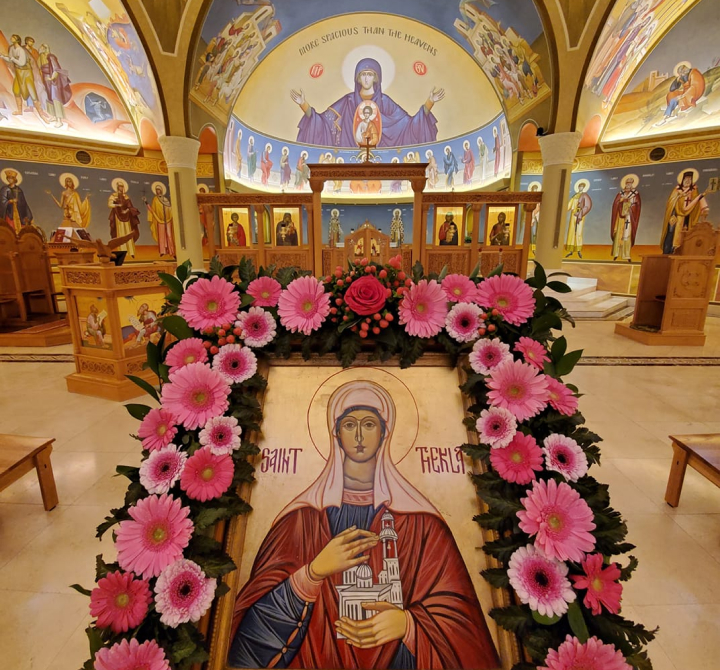
We invite you to “Come and see” the Orthodox Church. Visitors are welcome at our services and throughout the week. On weekdays, we are able to offer you tours of our church and the opportunity to meet with our clergy to have your questions answered regarding the Orthodox Faith. We have nearly two thousand years of history and theology that is expressed in the worship and Holy Tradition of the Church.
Welcome to St. George
The parish family of St George and the Orthodox Church welcome all those who are searching for the Church of the New Testament. The Orthodox Church is that Church with no interruption or change in its theology, apostolic succession, and worship as well as pastoral and ethical care. We believe that all people are created in the image and likeness of God. We invite you to visit the parish of St George for worship or to contact our clergy to learn more about our parish and the Orthodox Church.